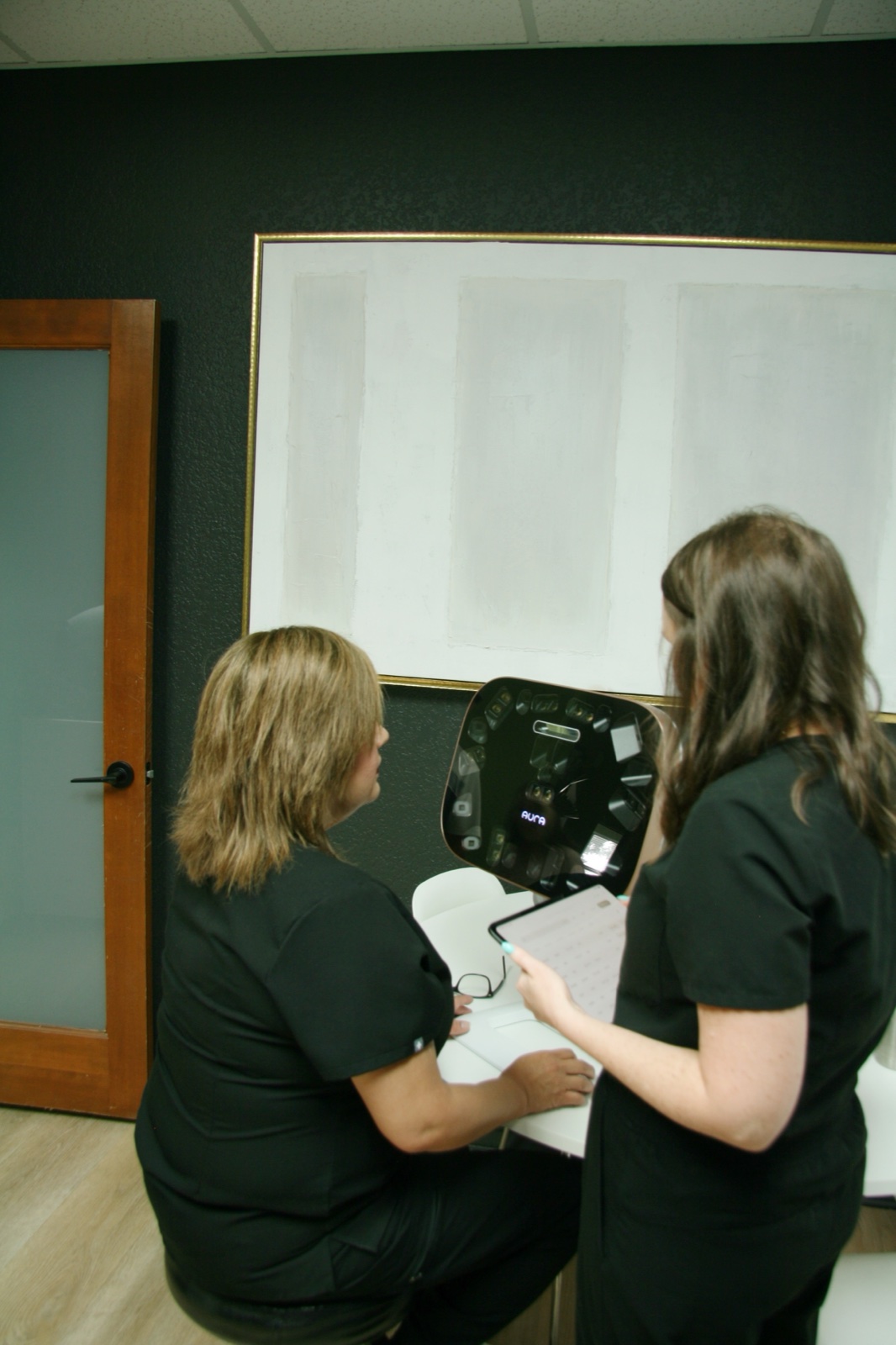
What to expect at your first Aura 3D skin analysis
Most aesthetic plans start the way they did fifty years ago: a clinician looks at your face, makes a judgment, and recommends a treatment. The judgment is informed by training and experience, but at the end of the day, it’s an opinion.
The Aura 3D platform — the Swiss-made imaging system Bespoke now uses for every aesthetic consult — replaces the opinion with data. Thirteen cameras and eighteen light sources capture your face in a single 0.2-second flash. The 575-megapixel reconstruction shows what’s on your skin, what’s under it, and what’s coming — benchmarked against people your age and skin type.
This piece walks through what actually happens at your first scan, so you arrive knowing what to expect.
Before you come in
The scan reads more accurately on bare skin, so we ask that you come in without makeup if possible. (If you can’t, that’s fine — we have a small dressing area and gentle cleansing wipes; budget five extra minutes.) Avoid fresh self-tanner for at least 48 hours before your scan, as it skews pigment readings.
You don’t need to fill out anything in advance. Your provider will take a brief history at the start of the visit — sun history, current skincare, anything you’ve had done in the last year, what you’d like to address.
The scan itself
You sit in front of a curved imaging tower about three feet across. A soft headband holds your hair back — this is the only contact the device makes with you. You’ll close your eyes and hold still while three exposures fire in succession: a frontal capture, a left three-quarter, and a right three-quarter. The total active scanning time is about twelve seconds; the entire seated portion runs under three minutes.
There’s no UV. No chemicals. No heat. No physical contact with your skin. Patients with sensitive eyes occasionally describe the flash as “like a phone camera, but brighter,” which is the right mental model — it’s simply a high-quality multi-source photographic capture, not a treatment.
Reading the scorecard
While you’re still in the chair, the 3D reconstruction processes in about forty seconds. By the time we’ve handed you a glass of water, the scorecard is on the screen. Five primary dimensions are graded, each compared against your age-and-skin-type cohort:
- Wrinkles — forehead, periorbital (crow’s feet), perioral (lip lines), and the 11s between brows
- Pores — density and size, region by region
- Brown spots (pigment) — including sub-surface pigment that hasn’t reached the visible skin yet
- Redness — including vascular patterns you may feel as warmth but can’t see
- Surface texture — smoothness, roughness, and the kind of fine irregularity that catches makeup
Each dimension comes back as a numerical score plus a regional heat map laid over your 3D facial model. Green is healthy, amber is developing, red is the area you want to address. Your provider walks you through it on the screen, rotating the model so you can see your face from angles a mirror never shows you.
The mirror flatters. Aura measures. That’s the difference between “I think it’s better” and “the wrinkle score on your forehead dropped from 42 to 27.”
Building the plan from the scan
Aura doesn’t prescribe treatments — your provider does. But the scan turns the conversation from generic recommendation to specific argument. If the pigment score on your right cheek is elevated and the sub-surface scan shows more is on the way, the case for Hollywood Spectra or LaseMD isn’t hypothetical — it’s right there in front of you, with a target number we can measure against in twelve weeks.
If your forehead wrinkle score is moderate but your dynamic patterns (what your forehead does when you raise your brows) are aggressive, we may recommend starting with neuromodulator placement rather than resurfacing. If the redness layer shows persistent vascular activity along your nose and chin, the conversation shifts toward Clarity II vascular settings rather than a peel.
None of this requires you to make a decision in the room. You’ll leave with a written sequenced plan — what to do first, what to layer in next, what to maintain — that you can take home and think about.
Re-scans: what makes the math work
The reason we built our practice around Aura isn’t just the first scan. It’s the re-scans every twelve weeks. Because the thirteen-camera capture is identical every time — same lighting geometry, same exposure, same angles — the before-and-after isn’t fudged by “you stood differently” or “the light was better that day.” You’re comparing two precise measurements of the same exact view.
That precision matters most in subtle work. A 0.1 mm change in surface depth is finer than a strand of hair, and well below what your eye can register on a face you see every morning. Aura sees it. Six months of scans laid on top of each other shows where collagen is rebuilding, where pigment is fading on schedule, and where a region isn’t responding the way the rest is — which is the signal that the plan needs to change.
What it costs and how to book
The Aura scan and scorecard review are included in your skin consultation. We don’t separate the scan as a billable line item because it’s the starting point of every aesthetic plan at Bespoke — it lives inside the consult itself.
If you’re an existing patient who’s never had an Aura scan, we’d like to put a baseline on the chart on your next visit. Call 737·275·0725 and ask the front desk to add one to your appointment.
New to Bespoke? Book a skin analysis — thirty minutes, scan included, plan written.