

A 20-minute visit. One half-second flash. You leave with your skin mapped in 3D — pigment, pores, redness, texture, depth — and a plan built on what's actually there, not what we guessed.
You sit down. A 20-second scan — one flash, nothing touches you, no downtime. A few minutes later, your clinician walks you through a 3D model of your own face, scored across the five things treatment actually addresses: wrinkles, brown spots, redness, texture, and pores.
What makes the difference: Aura sees beneath the surface. Pigment forming below the skin. Vessels not yet visible. Sub-surface redness you feel but can't point to. And it measures — to 0.1 mm — so when you come back in three months, we know whether something changed for real, not whether the lighting was different.
The result is a quantified baseline. Your plan is built on what's actually there. Your progress is measured, not eyeballed.

0.1 mm is finer than a strand of hair — about a hundred times more sensitive than your eye. That's why we can show you real change at twelve weeks instead of saying “I think it's better.” Thirteen cameras and eighteen light sources mean the same exact view every visit, so your before-and-after isn't tilted or shadowed differently. The numbers below are the reason the conversation about your skin can actually be honest.

The scorecard appears on the screen and we read it with you — not at you. Where pigment is forming, where collagen has thinned faster than the rest, what the data says vs. what the mirror shows. Then we write the plan from there.
To you it's one flash and a few minutes at the screen. Underneath, three things are happening at once — each one shows us something a regular photo, or a mirror, can't.
A flat camera can flatter or accuse — it can't measure. Twelve cameras capturing at once give us a true 3D model of your face, accurate to the width of a hair. So the things photos miss — depth, asymmetry, real volume change — become numbers we can act on together.
Cross-polarized lighting strips the shine off your skin so we can see what's developing underneath: pigment that hasn't surfaced yet, vessels you feel as warmth, early sun damage your mirror hasn't caught up to. Treat it before it becomes the thing you came in for.
Aura's AI was trained on thousands of people across five continents, every skin type, every age. So when your wrinkle or pore score comes back, it's benchmarked against people your age and skin type — not a beauty standard. “Good” or “developing concern” actually means something for your life.
Your scan returns an overall skin score plus individual grades on five validated dimensions — each one answering a question that should drive your plan. Compared against thousands of same-age, same-skin-type people, so the number isn't an impression. It's a benchmark.
Where am I aging fastest? Graded zone by zone on the Lemperle scale (1–5), so the Botox / Daxxify conversation starts with where you actually need it — not where the brochure suggests.
What's coming, not just what's here. Pigmentation often forms beneath the skin before it surfaces. Catch it now and you treat early — not after it's the thing in your mirror.
Why does my skin look reactive? Polarized imaging exposes subsurface redness tied to inflammation and vessels — the redness behind the redness you can see.
Is “texture” actually changing? Quantifies the fine wrinkles, scars, and post-acne marks that smoothing treatments target — so you can prove the microneedling or peel earned its keep.
Pores, or just texture? Most of what people call “pores” is actually texture. We tell the difference at 0.1 mm — so we don't sell you a pore treatment when the real answer is something else.

The first scan is just the start. Every scan after stacks on the last one, so the conversation evolves from “what's going on?” to “is what we're doing working?”
63 landmarks map your face in golden thirds and fifths. So when we talk about lift, balance, or symmetry, we show you the numbers — not invent a “flaw” to sell against.
Two scans, before and after, compared in 3D. We see the actual visible change in millilitres — usually less than what was injected, and that gap is where smarter dosing decisions get made.
Six months of scans laid on top of each other shows where tissue is shifting — from treatment, from aging, from weight loss. The mirror lies about gradual change. Aura doesn't.
Project potential outcomes in 3D before any needle goes in. Not a promise — a direction. Especially useful if you want to see what “a little” actually looks like before saying yes.


Who it helps.
A professional skin analysis looks beneath the surface to map what's really driving your concerns — and build a plan around it.
Sub-surface pigment, redness, and early sun damage surfaced before they become the problem you came in for.
Your plan addresses what the scan found — not the menu on the counter. Five scores plus a 63-landmark facial map make “less is more” specific.
Sub-millimeter scan-to-scan comparison shows real change in volume, texture, and tone — not “I think you look great.”
A skin analysis is the smartest first appointment - twenty minutes that shapes every skin decision after it.
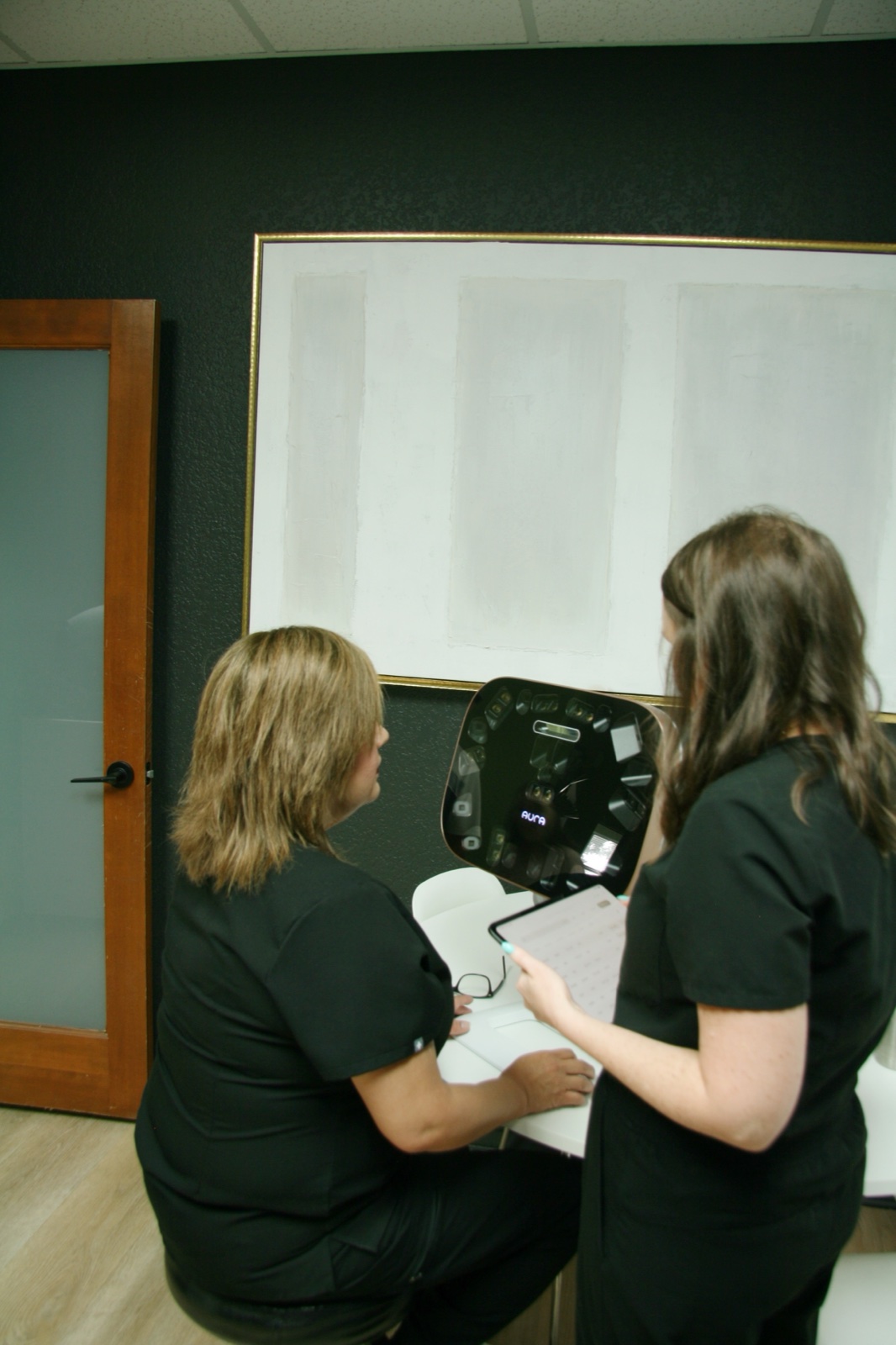
A 20-second flash maps pigment, pores, redness, texture, and depth. Every plan starts with what’s actually there.
Read this month →